When your fuel economy starts to slide, most people think of things like old spark plugs, low tire pressure, or a dirty air filter. The catalytic converter is usually not the first suspect. But when it starts to clog or melt internally, it can quietly choke off exhaust flow and make the engine work harder for every mile. That extra effort often shows up at the pump long before the car throws a major fit.
What the Catalytic Converter Actually Does
The catalytic converter sits in the exhaust stream between the engine and the muffler. Inside the metal shell is a honeycomb coated with precious metals that help burn off unburned fuel and harmful gases. As exhaust passes through, chemical reactions reduce pollutants before they leave the tailpipe.
For that to work, exhaust has to flow freely through thousands of tiny passages. If those passages start to plug with carbon, melted material, or debris, the converter turns from a cleaner into a restriction. The engine still runs, but it has to push harder to exhale.
How a Clogged Converter Steals Fuel Economy
Engines are air pumps. They breathe in fresh air and fuel, burn it, then push exhaust out. A restricted converter creates backpressure, which makes it harder for cylinders to empty completely. When exhaust does not clear well, the next intake stroke pulls in a mix of fresh charge and leftover gases.
The result is weaker combustion and less power per bang. To get the same acceleration or highway speed, you press the pedal farther, the engine uses more fuel, and your miles per gallon go down. In some cases, the computer will also start adjusting fuel trims, trying to compensate, which can hurt fuel economy even more.
Real-World Symptoms of a Restricted Converter
A converter that is starting to clog often acts up in ways that point to poor breathing rather than a simple tune-up problem. Drivers may notice:
- Power that feels normal around town but drops off badly on hills or at highway speeds
- A sensation that the engine “runs out of breath” when you try to accelerate hard
- Fuel economy dropping even though your driving habits have not changed
- Extra heat radiating from under the floor after longer drives
- A faint sulfur or rotten egg smell from the exhaust at times
These symptoms tend to creep in slowly. Many people chalk them up to age or extra cargo until the car feels noticeably sluggish.
Other Problems That Mimic a Bad Catalytic Converter
It is important not to blame the converter for every fuel economy issue. Several other problems can feel very similar from the driver’s seat. Weak ignition components, low fuel pressure, dragging brakes, and underinflated tires can all make the car feel lazy and thirsty. Engine sensors that read incorrectly can also cause the computer to add more fuel than necessary.
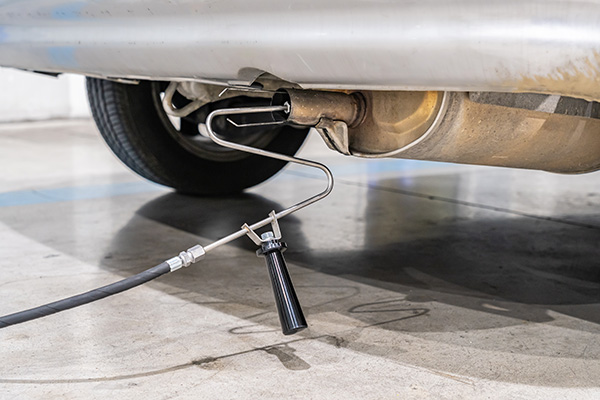
We like to start with basics: checking tire pressures, looking for brake drag, scanning for codes, and reviewing fuel trims and oxygen sensor readings. A truly restricted converter leaves a specific pattern in those numbers and sometimes in exhaust backpressure tests. That way, you are not paying for an expensive exhaust part when the real culprit is somewhere else.
Owner Habits That Can Damage the Converter
Catalytic converters usually do not fail on their own. They are often the victim of another problem upstream. Driving with long-term misfires lets raw fuel hit the converter, which overheats and melts the internal honeycomb. Burning oil or coolant can coat the substrate and keep it from doing its job.
Other patterns that shorten converter life include putting off repairs when the check engine light flashes, ignoring fuel or ignition issues for months, and using poor-quality fuel in engines that are already borderline. We have seen many converters ruined because a drivability problem was treated as an annoyance instead of something worth fixing early.
Is It Time to Have The Catalytic Converter Checked?
You do not need to diagnose it yourself, but a few questions can tell you whether it is time for a professional look. If your fuel economy has dropped noticeably, the car feels weaker at higher speeds, and there is a history of misfires or check engine lights that were never fully addressed, the converter and exhaust are worth a close inspection.
If the engine struggles badly on hills, feels like it is hitting a wall at higher rpm, or you notice strong sulfur smells or excessive heat under the floor, that moves things into the “sooner rather than later” category. At that point, testing backpressure, looking at sensor data, and inspecting the exhaust can confirm whether the converter is the main issue or just part of a larger problem.
Get Catalytic Converter Diagnosis in Brentwood, CA, with Monkey Wrenches
We diagnose fuel economy and power loss complaints every day and know how to tell a clogged converter from other issues that feel similar. We can test exhaust flow, check for underlying problems that may have damaged the converter, and recommend repairs that restore both performance and mileage.
Call Monkey Wrenches in Brentwood, CA, to schedule a catalytic converter inspection so you know exactly why your fuel efficiency is dropping.