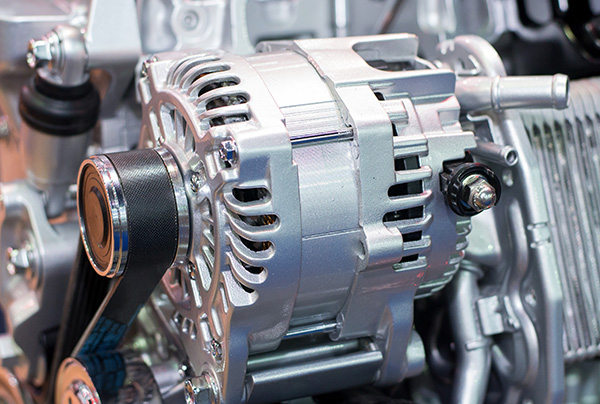
A squealing or rattling serpentine belt does not always mean the belt itself is worn out. On some vehicles, the alternator pulley has a clutch or decoupling mechanism inside it. When that pulley begins to seize or wear out, it can upset the entire belt drive.
You may hear noise around the front of the engine, see the belt tensioner jump more than normal, or notice inconsistent charging voltage. Because several belt-driven components can cause similar symptoms, you should check the pulley along with the alternator, tensioner, idlers, and belt condition.
Some Alternator Pulleys Do More Than Simply Spin
A traditional solid alternator pulley turns directly with the serpentine belt. Many newer vehicles use an overrunning alternator pulley or alternator decoupler instead.
The purpose is to let the alternator react more gently when engine speed changes. The alternator rotor has considerable mass and does not speed up or slow down instantly. A clutch-style pulley helps absorb those changes so the belt does not get pulled and released sharply every time you lift off the accelerator or the transmission shifts.
A Seized Pulley Can Make the Belt Tensioner Jump
When an overrunning pulley locks up internally, it loses the ability to freewheel or dampen vibration. The alternator then acts more like a solid load against the belt.
One clue we look for is excessive tensioner movement at idle. A healthy tensioner will move slightly as the engine runs, but it shouldn't constantly snap back and forth. A seized alternator pulley can make that movement much more aggressive, especially when engine speed drops quickly.
Belt Chirping or Rattling Can Come From the Pulley
A failing pulley can create several different sounds depending on how it is wearing. You may hear chirping, rattling, light knocking, or a brief belt squeal during startup or shutdown.
The noise can be confusing because it may sound like an idler pulley, tensioner bearing, or worn belt. At our shop, we listen for when the sound occurs and check each pulley before replacing the belt. A new belt installed over a faulty pulley often becomes noisy again because the real source was never repaired.
Pulley Bearing Wear Can Create Roughness and Play
Not every alternator pulley problem involves the clutch mechanism. Bearings and internal pulley components can wear enough to create rough rotation or side-to-side movement.
With the belt removed, a technician can check the pulley and other accessories for looseness, binding, or rough spots. The exact test depends on the pulley design because an overrunning pulley is supposed to rotate differently in one direction than the other. Knowing how that particular pulley should behave is important before calling it failed.
A Bad Pulley Can Eventually Affect Charging
The alternator has to be driven at the correct speed to maintain battery voltage and supply the vehicle's electrical system. If a pulley slips internally, binds badly, or causes the belt to lose proper contact, alternator speed can become inconsistent.
That can lead to a battery warning light, low charging voltage, dimming lights, or a battery that keeps running down. In more severe cases, the belt can overheat or come off completely. Once that happens, the alternator stops charging, and other belt-driven accessories, such as the water pump, may also stop operating on engines that share the same belt.
Do Not Blame the Alternator Too Quickly
A charging problem doesn't automatically mean the alternator has failed. A weak battery, corroded cable, damaged ground, loose belt, failed tensioner, or pulley problem can all interfere with charging performance.
During an inspection, we look at charging voltage, electrical load, belt tracking, tensioner movement, and the physical condition of the pulley system. That gives us a better picture of whether the alternator has an internal electrical problem or whether the pulley and belt drive are keeping a good alternator from working correctly.
A Failed Pulley Can Damage Other Belt Components
Ignoring a bad alternator pulley can put extra stress on the serpentine belt and tensioner. Constant vibration makes the tensioner work harder, while poor alignment or rough pulley movement can wear the belt edges and ribs.
Over time, you may end up replacing several parts instead of one. A belt that starts fraying, glazing, or walking sideways across a pulley needs attention. Regular maintenance gives us a chance to spot abnormal belt wear or tensioner movement before the belt drive reaches the point of failure.
Sometimes the Pulley Can Be Replaced Separately
On some alternators, you can service the pulley without replacing the entire alternator. That makes sense when the alternator tests well electrically and the pulley is clearly the only failed component.
Other designs make separate pulley replacement less practical, or the alternator may already have bearing or charging problems. We consider the alternator's condition, mileage, parts availability, and labor involved before recommending the repair. The goal is to fix the cause of the noise and restore dependable charging without replacing good parts unnecessarily.
Get Alternator and Belt Drive Service In Brentwood, CA, With Monkey Wrenches
If your vehicle has belt noise, a jumping tensioner, a battery warning light, or inconsistent charging, Monkey Wrenches in Brentwood, CA, can check the alternator pulley, serpentine belt, tensioner, idlers, and charging system.
Schedule a charging and belt-drive check before a failing pulley damages the belt or leaves the battery without a reliable charge.